Yes I use the .morph files.
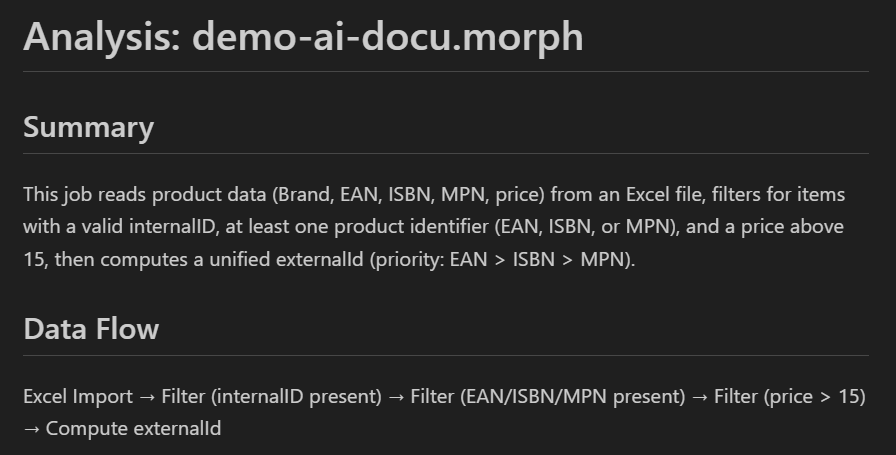
Currently, for example, I use it for documenting more complex jobs. I often have various filters on a dataset – sometimes with calculated intermediate fields and extra queries to check if it's empty, etc. AI can then easily summarize this into a business logic that even non-IT professionals can understand.
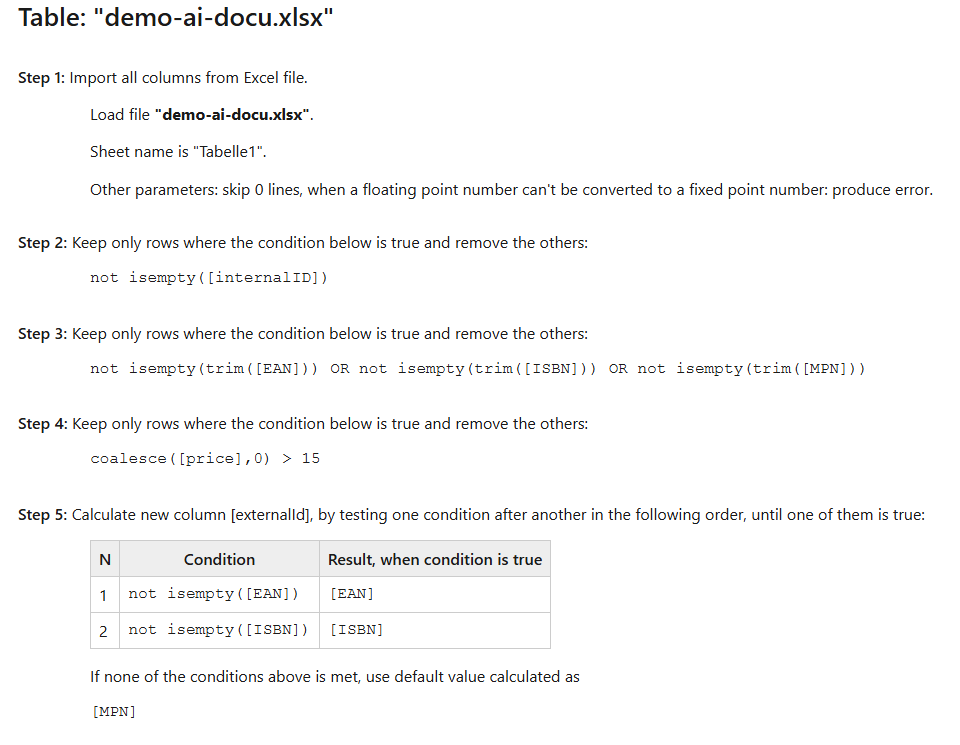
Because there was a mention of Easymorph's documentation function – yes, it exists, and it's good if you want to know the details. But it's not suitable for non-technical people or those who only want a rough overview.
Here's a very simple example – and please don't criticize the flow's logic – it's just meant to illustrate the differences.
And documentation is just the beginning – I already see potential in modifying flows or having entirely new ones written.
In contrast to complete programming by AI, Easymorph makes reviewing or verifying with real data (which I can never use with external AI) much easier. This way, combining "both worlds" can deliver real added value.
I have tried it as well and initial results are promising especially for new workflow creation. But it comes back to “is it easier to do it yourself?” because in most of the action steps, you aren’t necessarily writing code and the time you take you write a detailed prompt for the LLM, you might be fairly progressed with the build itself.
I do see the benefit of AI based summaries for the business users vs the technical documentation that easymorph itself generates.